 how-to
How to Build a Non-Toxic Skin Care Routine for Post-Radiation Skin in 2026
Last Updated: November 7, 2026
Quick Summary
Post-radiation skin care means cleansing, moisturizing, and protecting skin in and around the radiation field with gentle, low-irritant products. Build your routine in phases: a fragrance-free cleanser, an approved plain moisturizer, and loose clothing during treatment, then reintroduce one new product at a time only after your team confirms full healing.
- Ask your radiation oncology team which products they recommend or restrict before buying anything.
- Cleanse once or twice daily with lukewarm water and a gentle cleanser, then pat dry without rubbing.
- Avoid fragrance, essential oils, drying alcohols, acids, and retinoids on the treatment field.
- Patch test new products on healthy skin away from the field and wait 24 to 48 hours.
- Protect treated skin from sun for at least a year on most clinician guidance.
Table of Contents
- Step 1: Follow Radiation Therapy Skin Care Guidelines From Your Treatment Team
- Step 2: Cleanse Gently to Protect the Skin Barrier
- Step 3: Choose the Best Lotion for Radiation Treatment and Barrier Repair
- Step 4: Know Which Ingredients to Avoid on Post-Radiation Skin
- Step 5: Use Natural Remedies for Radiation Burns With Clinical Boundaries
- Step 6: Answer How Long Should I Stay Out of the Sun After Radiotherapy
- Step 7: Build a Phase-Based Post-Radiation Skin Care Routine for 2026
- Get Personalized Guidance for Your Skin Recovery Plan
- Frequently Asked Questions
Step 1: Follow Radiation Therapy Skin Care Guidelines From Your Treatment Team
Building the best non-toxic skin care routines for sensitive post-radiation skin in 2026 starts with one rule: your radiation oncology team's instructions come first. Radiation therapy affects the skin in the treated area, and reactions vary by dose, body site, and skin type. Patients often gather advice online before asking the people who know their treatment plan.
Post-radiation skin care is the practice of cleansing, moisturizing, and protecting skin in and around the radiation field using gentle, low-irritant products. The goal is to support the skin barrier while it recovers.
Before you buy anything, ask your team four questions:
- Which products do you recommend or restrict?
- Can I use lotion during treatment, and when?
- Should I avoid heat, sun, or tight clothing on the area?
- Which symptoms should I report right away?
Guidance from the American Cancer Society on radiation therapy side effects notes that skin reactions usually build gradually and settle after treatment ends. Your team can tell you what is normal for your case.
Watch out: never apply a new product to irritated skin in the treatment field without checking first. Some ingredients interfere with treatment or worsen reactions.
Step 2: Cleanse Gently to Protect the Skin Barrier
The skin barrier is the outer layer that holds moisture in and keeps irritants out. Radiation can weaken it, so cleansing needs to be soft, short, and simple.
Follow these habits:
- Use lukewarm water, never hot
- Choose a gentle cleanser or cleansing oil instead of bar soap
- Skip washcloths, loofahs, and scrubbing
- Pat dry with a soft towel, don't rub
- Cleanse once or twice daily, not more
Fragrance-free and hypoallergenic formulas reduce the chance of irritation. Avoid products with synthetic fragrance, essential oils, or drying alcohols in the treatment area.
The FDA guidance on cosmetics and skin products explains how labels use terms like "hypoallergenic," which is worth understanding before you pay more for a claim.
If skin is open, weeping, or blistered, stop cleansing products and call your team.
Step 3: Choose the Best Lotion for Radiation Treatment and Barrier Repair
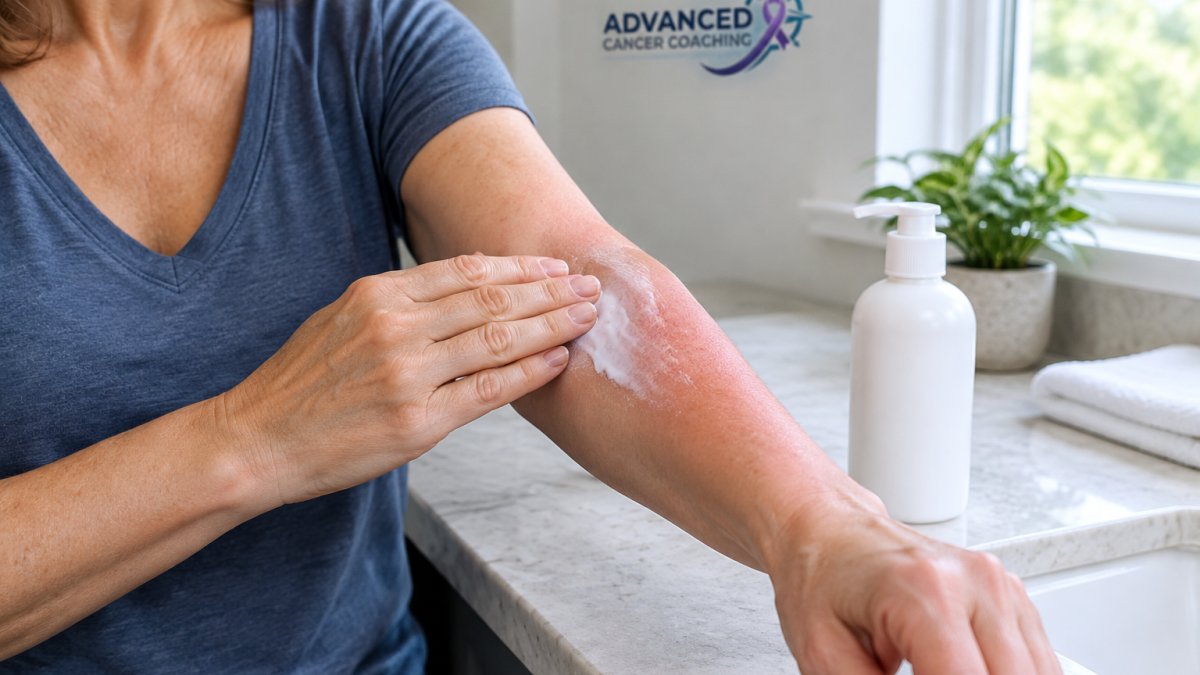
The best lotion for radiation treatment is one your care team approves, fragrance-free, and rich enough to support barrier repair without stinging. Plain moisturizers often do the job.
Look for these features:
- Fragrance-free and dye-free formulas
- Barrier-supporting ingredients such as hyaluronate, peptides, or calendula
- Simple ingredient lists with few preservatives
- Thick creams or balms for dry, flaky areas
Apply moisturizer gently after cleansing, while skin is still slightly damp. Ask your team about timing around treatment sessions, since some centers prefer you arrive with clean skin.
A thin layer, applied gently several times a day, is generally easier on irradiated skin than a heavy application that traps heat.
Step 4: Know Which Ingredients to Avoid on Post-Radiation Skin
Certain ingredients raise the risk of irritation, allergic reaction, or worse on compromised skin. The useful question is not "natural or synthetic" but "what does this ingredient do to a barrier that is already weakened." Below is a practical use/avoid/caution breakdown for the ingredients patients ask about most.
| Ingredient category | Verdict on irradiated skin | Why | Practical note |
|---|---|---|---|
| Added fragrance (synthetic or "natural") | Avoid | Fragrance mix is among the most common causes of allergic contact dermatitis, and damaged skin sensitizes more easily | "Unscented" and "fragrance-free" are not the same; unscented can contain masking fragrance |
| Essential oils (lavender, tea tree, peppermint, citrus) | Avoid on the field | Concentrated plant volatiles irritate broken skin and can cause allergic reactions | Never apply undiluted; "aromatherapy" and "botanical" labels often hide them |
| Drying alcohols (denatured alcohol, SD alcohol) | Avoid | Strip lipids from an already compromised barrier | Cetearyl alcohol and stearyl alcohol are fatty alcohols and are generally fine |
| Acids and retinoids (glycolic, salicylic, lactic, retinol, tretinoin) | Avoid during treatment and early recovery | Increase turnover and stinging on skin that cannot tolerate exfoliation | Reintroduce only after the team confirms full healing |
| Preservatives (parabens, methylisothiazolinone, formaldehyde releasers) | Caution | Methylisothiazolinone in particular is a recognized sensitizer; parabens are lower-risk for most people | A short ingredient list with a well-tolerated preservative system beats a "preservative-free" product that can grow microbes |
| Barrier-supporting ingredients (hyaluronate, glycerin, ceramides, petrolatum, dimethicone) | Use | Humectants draw water in, occlusives reduce water loss, ceramides support the lipid barrier | Petrolatum is a common occlusive ingredient |
| Calendula and colloidal oatmeal | Caution to use | Some clinicians support calendula creams; colloidal oatmeal can soothe itching | Confirm with the team, and stop if stinging or redness increases |
What "non-toxic" actually means on a label. "Non-toxic" has no legal definition in skin care, and neither does "clean." The FDA does not certify these terms, so treat them as marketing until you read the ingredient list. "Hypoallergenic" is also largely a claim rather than a standard.
Patch testing, done properly. Apply a small amount to healthy skin away from the treatment field, wait 24 to 48 hours, and check for redness or itching before using it on irradiated skin. Do not patch test on the radiation field itself without clinician guidance.
Watch out: if a product stings, burns, or causes spreading redness on the field, stop it and call your radiation oncology team rather than layering another product on top.
Step 5: Use Natural Remedies for Radiation Burns With Clinical Boundaries
Natural remedies for radiation burns can soothe skin, but only within clear limits. Some clinicians discuss calendula-based creams with patients.
Set these boundaries:
- Never apply undiluted essential oils to the treatment field
- Skip home remedies on open, blistering, or weeping skin
- Confirm every remedy with your oncology care team first
- Stop anything that causes stinging, redness, or itching
Natural does not mean risk-free. Botanical extracts can trigger allergic reactions, especially on a weakened skin barrier.
For readers exploring gentle, evidence-aware options, our guide to non-toxic healing modalities for resilience explains how we frame safe complementary approaches alongside standard care.
Step 6: Answer How Long Should I Stay Out of the Sun After Radiotherapy
How long should I stay out of the sun after radiotherapy? Treated skin stays sensitive to UV for weeks to months after treatment ends, and some clinicians advise protecting the area for at least a year. Ask your team for a timeline that fits your dose and site.
Protect the area by:
- Covering it with clothing or a hat
- Using broad-spectrum sunscreen on healed skin, as approved
- Avoiding peak sun hours and tanning beds entirely
- Steering clear of hot packs, heating pads, and saunas on the field
Sun exposure can darken treated skin and worsen irritation. Heat does the same. Treat the area like fresh skin that needs shade and gentle care.
Step 7: Build a Phase-Based Post-Radiation Skin Care Routine for 2026
A phase-based routine matches products to how your skin is actually healing, rather than applying one generic sensitive-skin plan across the whole recovery. This is the angle most guides skip, and it matters because the skin in the radiation field changes week by week.
Phase 1, During treatment (weeks 1 through the final session). Keep the routine to three moves: a fragrance-free gentle cleanser, an approved plain moisturizer, and loose clothing over the field. Most radiation oncology teams ask patients to arrive with clean, product-free skin on treatment days and to avoid lotion immediately before a session unless told otherwise, because residue can affect setup and skin dose. Apply moisturizer after the session and again in the evening. Do not add exfoliants, retinoids, vitamin C serums, or anything with a tingle.
Phase 2, Immediately after treatment (roughly the first two to four weeks post-treatment). Skin reactions often peak after the final session rather than during it, so this is the wrong moment to celebrate by trying a new "recovery" serum. Hold the same three-step routine, keep moisturizing several times a day, and continue to avoid heat, sun, friction from tight straps, and hot showers on the field. If the skin is intact but itchy, a cool compress for a few minutes at a time is usually safer than adding an anti-itch active. This is also the window when radiation dermatitis can worsen rather than improve, so keep the treatment team in the loop.
How to introduce anything new when the barrier is compromised. Patch testing on the radiation field itself is not a good idea without clinician guidance, because the field is the most vulnerable skin you have.
Safety boundaries that override any routine. Stop the product and contact the radiation oncology team promptly for worsening pain, blistering, open or weeping skin, spreading redness, warmth, swelling, fever, or any sign of infection. These are not "try a different moisturizer" situations.
For a wider view of rebuilding daily life, our 7 steps to improve quality of life after cancer treatment pairs well with this skin-focused plan.
Get Personalized Guidance for Your Skin Recovery Plan
Generic advice only goes so far. Your treatment plan, skin type, and cancer type shape what works, and a coach who understands both nutrition and recovery can help you sort through conflicting tips.
Advanced Cancer Coaching offers personalized sessions by phone, Zoom, or in person. Led by Mark Simon, Founder and Director of the Nutritional Oncology Research Institute, we focus on precision nutrition and lifestyle support that complements your oncology care, never replaces it.
If you want help choosing a coach, read how to choose a cancer coach. Ready to move forward? See how to book cancer wellness coaching in 2026. Curious about pricing first? Our guide covers the cost of personalized cancer health coaching in 2026.
Sensitive post-radiation skin asks for patience and simple products, not a shelf full of remedies. Start with your treatment team's guidance, then build a gentle routine phase by phase.
Frequently Asked Questions
What is best to put on skin after radiation treatment?
A fragrance-free, hypoallergenic moisturizer is the standard recommendation for post-radiation skin. Look for barrier-supporting ingredients such as hyaluronate, peptides, and ceramides, and apply while skin is still slightly damp after cleansing. Avoid products with synthetic fragrance, essential oils, parabens, or phthalates. Your oncology care team may recommend a specific lotion for radiation treatment based on your skin's reaction, so confirm any product with them before applying it to the treatment field.
Which ingredients should I avoid on skin affected by radiation?
Skip synthetic fragrance, essential oils, botanical extracts, parabens, phthalates, alcohol-based toners, and exfoliating acids such as glycolic or salicylic acid. These can trigger irritation, burning, or peeling on compromised post-radiation skin. Also avoid hot water, harsh scrubs, and adhesive bandages directly on the treatment field. Patch testing a small area of unaffected skin first is a practical way to check tolerance before applying a new product to irradiated skin.
How long should I stay out of the sun after radiotherapy?
Treated skin stays more sensitive to UV exposure for months after radiation ends, and some effects persist longer. Keep the radiation field covered with clothing or a broad-spectrum sunscreen of SPF 30 or higher, and ask your oncology care team for a specific timeline based on your dose and skin response. Avoid direct sun during peak midday hours, and never rely on sunscreen alone on skin that is still peeling, blistering, or open.
Can natural remedies help with radiation-related skin irritation?
Some clinicians discuss gentle options such as calendula-based creams and colloidal oatmeal with patients, and reactions vary. Avoid essential oils, botanical extracts, and homemade pastes on the treatment field, since these can cause contact irritation or infection on open skin. Check any natural remedy with your oncology care team first, and stop immediately if redness, burning, or blistering worsens.